If your store converts at 2%, you're losing 98 out of every 100 visitors you paid to bring in. CRO is the discipline that fixes that
July 15, 2026
Spend more on ads. Bring in more traffic. Scale the top of the funnel. For most D2C brands, this is the default growth playbook, and it makes sense on the surface. More visitors should mean more sales.
But here's the thing: if your store converts at 2% (average conversion rate), you're losing 98 out of every 100 visitors you paid to bring in. Running more ads doesn't fix that problem, it just makes it more expensive.
This is exactly what Conversion Rate Optimisation (CRO) is built to solve. Not by getting more people through the door, but by making your store work harder for the visitors who are already there.
This guide breaks down what CRO actually is, why it matters more than most D2C brands realise, where stores typically lose people, and what strategies genuinely move the needle.
So, What Exactly is CRO?
Conversion Rate Optimisation is the practice of increasing the percentage of visitors who take a desired action. In ecommerce, that's usually a purchase, but CRO applies across the whole funnel. Clicking through to a product page, adding to cart, completing checkout — these are all conversions worth optimising.
The formula is simple:
Conversion Rate = (Conversions ÷ Total Visitors) × 100
If 10,000 people visit your Shopify store in a month and 200 make a purchase, your conversion rate is 2%.
What makes CRO so compelling is the leverage. Increase that rate from 2% to 3% without spending another penny on ads, and you've grown revenue by 50%. Same traffic, better results.
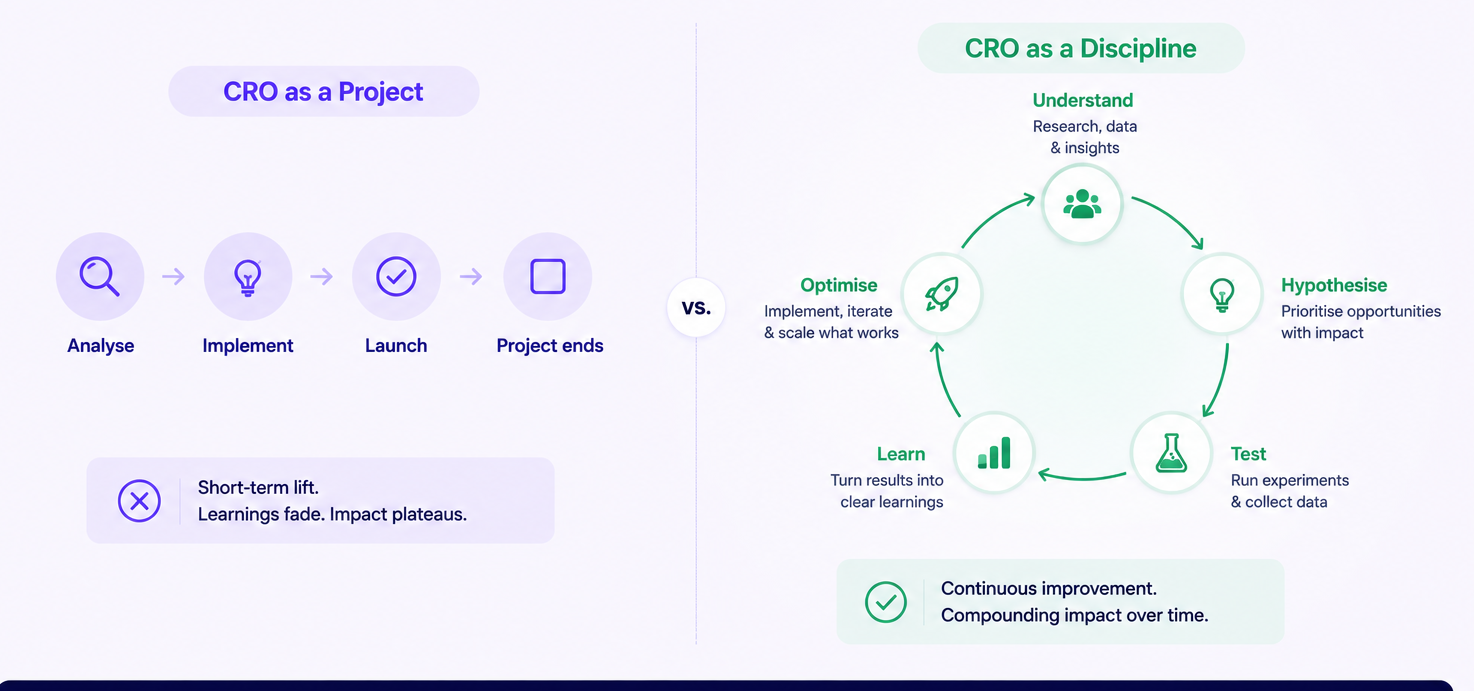
CRO isn't a one-time project or a single tool you install and forget. It's an ongoing practice — understanding why visitors behave the way they do, finding where they drop off, and steadily improving those moments over time.
What Should Your Shopify Conversion Rate Actually Be?
The honest answer: it depends. But benchmarks are still worth knowing.
Across ecommerce broadly, average conversion rates sit between 1% and 3%. Top-performing Shopify stores with strong brand loyalty, well-crafted product pages, and frictionless checkout regularly hit 4% to 5% or higher.
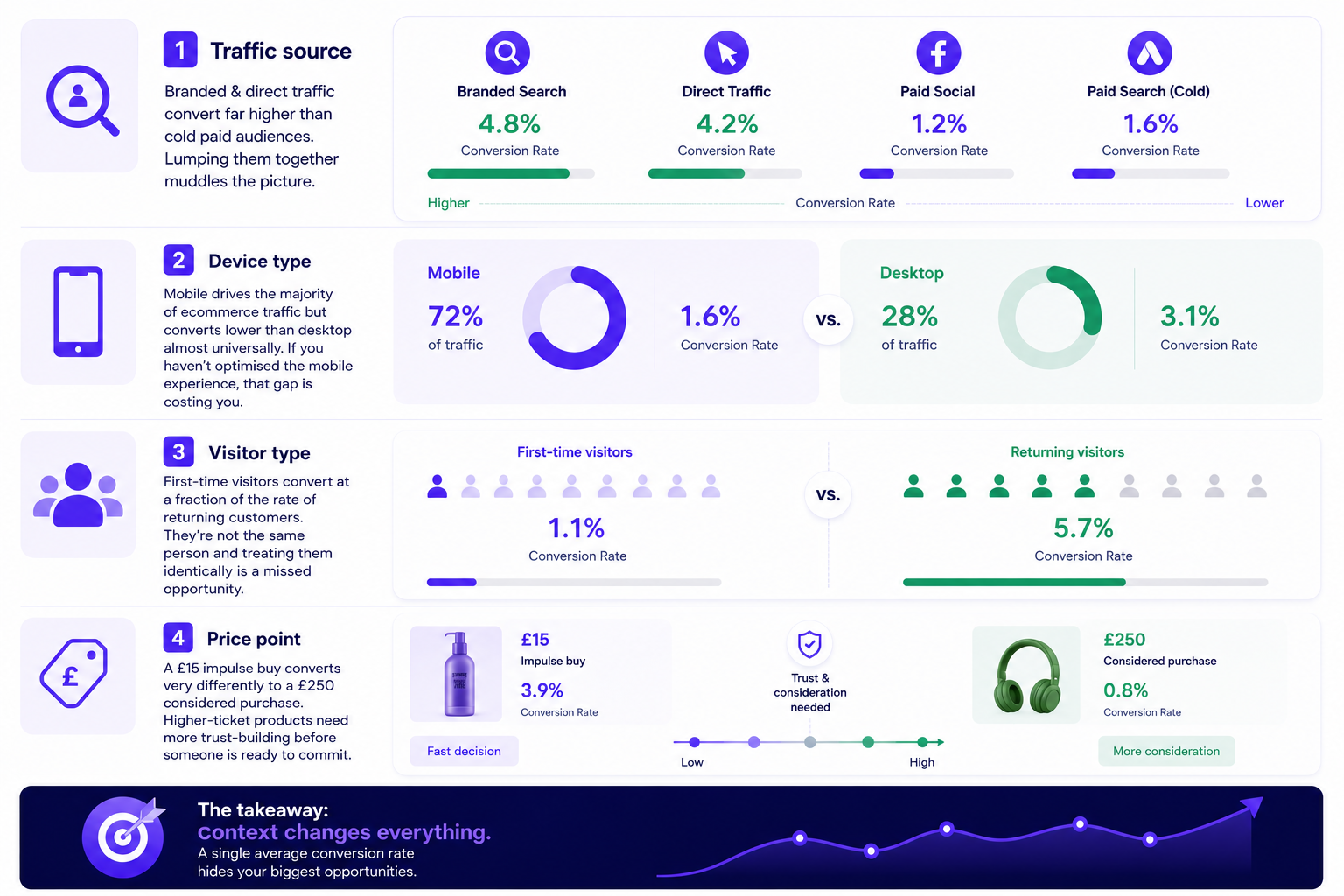
The overall conversion rate, however, is just an average. It hides a lot. A few things that dramatically shift what's 'normal' for your store are:
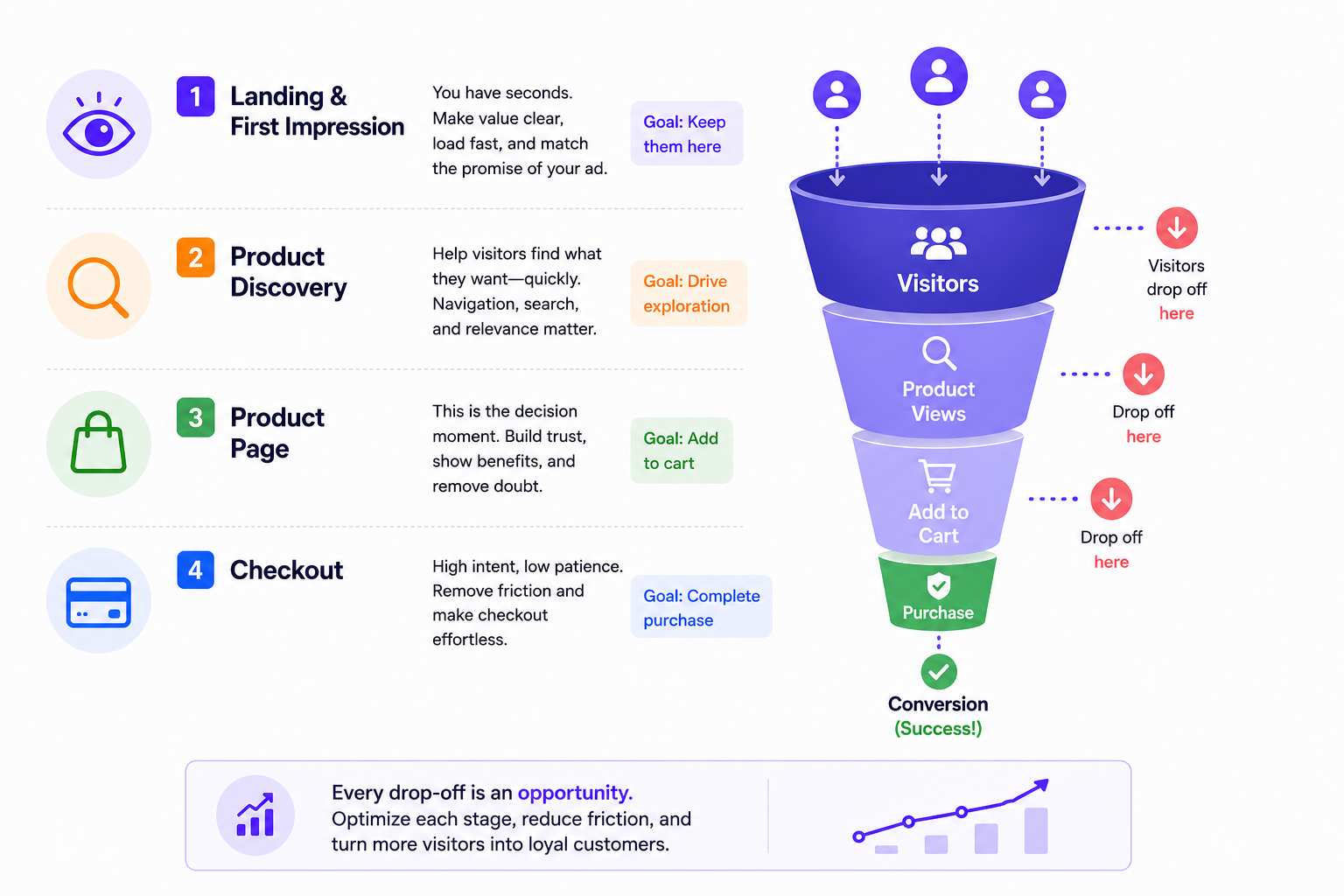
The Four Stages Where D2C Brands Lose Conversions
Conversion loss isn't random. Most D2C stores lose visitors at the same predictable points. Know these four stages and you know where to look first.
The Most Common CRO Mistakes D2C Brands Make
Understanding where to look is one thing. But a lot of brands are already caught in patterns that quietly undermine their results. These are the ones worth watching for:
Mistake 1: Treating all traffic the same Your store gets multiple types of visitors — first-timers from paid social, loyal customers coming back directly, high-intent searchers from Google. One generic experience can't serve all of them well. The stores that convert consistently are the ones that think in segments.
Mistake 2: Optimising for the average visitor. A returning visitor and a cold organic visitor are in completely different mindsets. When you blend all your traffic together and optimise for the whole, you end up optimising for no one in particular.
Mistake 3: Reaching for discounts. Discounting works in the short term, but it's a costly habit. It compresses margins, and over time it trains customers to wait for a sale instead of buying at full price. Good CRO finds ways to lift conversion without touching price.
Mistake 4: A/B testing without enough traffic. Statistical significance isn't a technicality, it's what makes a test result trustworthy. Testing on low volumes produces noise, not insight. If you don't have the traffic to reach significance quickly, focus on high-impact qualitative changes first.
Mistake 5: Starting at checkout. Checkout is the last step, not the only one. Most conversion loss happens earlier — on the product page, during discovery, sometimes before a visitor even scrolls. Fixing only the bottom of the funnel leaves most of the opportunity untouched.
Five CRO Strategies That Actually Move the Needle
These are the highest-impact starting points, not because they're complicated, but because most stores haven't done them properly.
1. Segment your visitors, not just your audience. New visitors, returning customers, mobile users, paid social traffic — they all behave differently and need different things. Stop optimising for the average visitor and start identifying which segment is actually driving your conversion problem. That's where the work belongs.
2. Fix the funnel before you fill it. Before spending more on ads, find out where your current traffic is dropping off. A store that fixes its product page drop-off from 1.5% to 2.5% conversion has effectively gained 67% more traffic at zero acquisition cost. Plug the leaks first.
3. Build trust at every stage. Trust isn't built on one page, it compounds across the entire journey. Social proof on the landing page, verified reviews on the product page, security signals at checkout. Think of it as a balance sheet: every friction point is a withdrawal and every trust signal is a deposit. The balance needs to be positive by the time someone hits buy.
4. Reduce friction at checkout. Guest checkout, fewer form fields, transparent shipping costs, and the payment methods your customers actually use. These aren't sophisticated changes but they're consistently the ones that move checkout completion rates most. For Shopify stores, enabling ‘Shop Pay’ alone produces a measurable lift.
5. Test systematically, not randomly. One variable at a time. A clear hypothesis before you start. Statistical significance before you call a result. Document both wins and losses, as well know that the losses are often more instructive. CRO compounds when every test makes the next one smarter.
How to Measure CRO?
You can't improve what you don't measure. These are the numbers that give you a real picture of your funnel and tell you where to focus.
Conversion Rate - Your baseline. Track it over time and by segment, not just as one aggregate number.
Bounce Rate by Page and Traffic Source - A high bounce on a specific landing page points to a first-impression problem. A high bounce from a specific traffic source usually points to a targeting or messaging mismatch.
Add-to-Cart Rate - If this is high but overall conversion is low, your problem is at checkout, not on the product page.
Cart Abandonment Rate - The percentage of carts that never become orders. Improving this is often the fastest path to recovering lost revenue.
Revenue Per Visitor (RPV) - Revenue divided by total visitors. This captures both conversion rate and average order value in a single number, making it the most commercially meaningful metric in your CRO toolkit.
Checkout Completion Rate - The percentage of people who start checkout and finish it. Anything below 60–65% is worth investigating.
CRO Is a Discipline, Not a Project
The most common CRO mistake of all might be this one: treating it as a sprint. A few weeks of improvements, a lift in conversions, and then back to business as usual. CRO doesn't work that way.
Every improvement you make raises the baseline. A product page tweak that moves conversion from 2% to 2.4% doesn't just improve this month, it improves every month after that. Stack a few of those gains across a year and the effect compounds significantly.
Building a sustainable CRO practice comes down to a few things:
A regular testing calendar, not just changes made when something feels off
A prioritisation framework. Start with high-traffic, high-drop-off pages where the potential impact is greatest
Time set aside to review results and feed what you learn into the next round of tests
Tools that reduce the operational overhead so the cycle doesn't stall every time you need developer support
Platforms like Cooee help here. Running personalisation experiments and surfacing visitor behaviour data without needing engineering resource for every test. But the discipline itself is something every brand needs to build, regardless of tooling.
Final Thought
CRO is ultimately a mindset shift. It moves the question from "how do I get more visitors?" to "how do I build something worth visiting?"
Every person who lands on your store found you somehow, clicked through, and showed up with some level of interest. That's not nothing. CRO is the discipline of taking that seriously. Remove the friction, earn the trust, and make it easy for people to do the thing they already came to do.
The brands that grow without being entirely at the mercy of ad costs are the ones that do this consistently. They test deliberately, they think in segments, and they treat their store as something to be continuously improved, not set and forgotten.
That's a more resilient way to build. And it starts with taking conversion seriously.
Ready to see where your Shopify store is losing conversions? Cooee's intent audit gives you a detailed breakdown of your visitor behaviour and where your funnel is leaking — free for Shopify stores. → apps.shopify.com/cooee-engage-your-customers

.png)