How Eume Grew Revenue Across Every Funnel Stage Without a Single Discount
About EUME
Eume is a direct-to-consumer luggage brand built around design-led, premium-material travel gear. They operate in a segment where the purchase decision is considered, emotional, and highly context-dependent. Customers arrive with intent.
Their Shopify store was attracting quality traffic from targeted travel and lifestyle campaigns, but every visitor, whether a business traveller clicking a paid ad or a first-time organic visitor, landed on the same generic homepage. The gap between traffic quality and onsite experience was creating costly leaks at every stage of the funnel.
Where Revenue Was Leaking
The traffic was good. The campaigns were targeted. But somewhere between the ad click and the checkout, revenue was slipping away - at the top of the funnel, in the middle of the catalogue, and at the very last step before payment.
At the top of the funnel, every paid visitor, regardless of what brought them there, landed on the same homepage, seeing the same categories. A business traveller clicking a targeted campaign ad and a first-time organic visitor were getting identical experiences. Intent was arriving. The storefront wasn't reading it.
In the middle of the funnel, the Aluminium collection, which is Eume's premium range, had stalled. The obvious move was a markdown. But discounting a premium SKU doesn't just clear stock, it resets the price expectation for every future buyer who visits after.
At checkout, a COD-heavy payment mix was doing quiet damage. Every undelivered order triggered a cascade including reverse logistics, repackaging, and lost fulfilment capacity. Costs that don't surface cleanly in dashboards but compound fast at scale.
Each problem was distinct. Each needed a targeted intervention. And none of them could be solved with a discount.
What We Deployed
Eume's storefront had three distinct drop-off points. Cooee built a targeted personalization layer for each one, activated by real-time behavioral signals, with no engineering changes to the store.
01 — Intent-Matched UTM Collection Tiles
The collection strip is the first navigation signal a visitor encounters on landing. For Eume, it was static, showing the same product-category taxonomy to every visitor, regardless of whether they arrived from a travel-intent campaign or a generic search.
Cooee made the collection tile strip respond dynamically to UTM parameters in real time. Travel-campaign visitors saw a use-case-led navigation experience built for their context. General visitors continued to see the standard brand-led category strip.
Generic UTM — Before
Travel UTM — Intent-Matched
Shop by use
Shop Luggage
Shop Messengers
Shop Backpacks
Travel Sets
Travel Accessories
Wherever you go, there's a Eume for it
Business Travel
Frequent Flyers
Family Trips
Short Trips
Travel-intent visitors saw journey-based navigation — categories that mirror the mental frame of the ad they had just clicked.
General visitors continued to see standard brand navigation, keeping the experience relevant to their discovery mode.
No backend engineering was required. The personalization layer sat entirely within Cooee's intent-reading system, with zero changes to Eume's storefront code.
The +15% lift in view-product and add-to-cart rate came purely from relevance, not discounting, not new creative, not increased ad spend. Travel-intent users saw travel use cases, not product categories. Simple logic, high return.
02 — Gift With Purchase Bundles on Aluminium
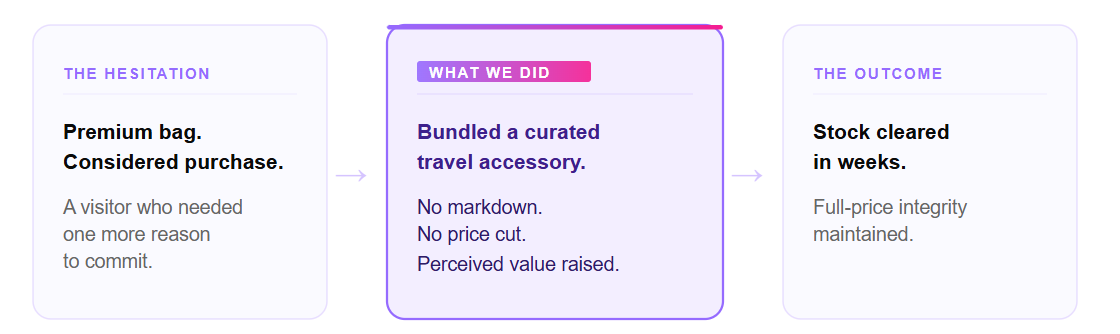
When premium inventory stalls, the reflex is to mark it down. For Eume's Aluminium collection which is the top of their price range, that would have been the wrong call. A markdown trains future buyers on a lower price ceiling, signals that the full price is negotiable, and permanently compresses margin on every clearance unit.
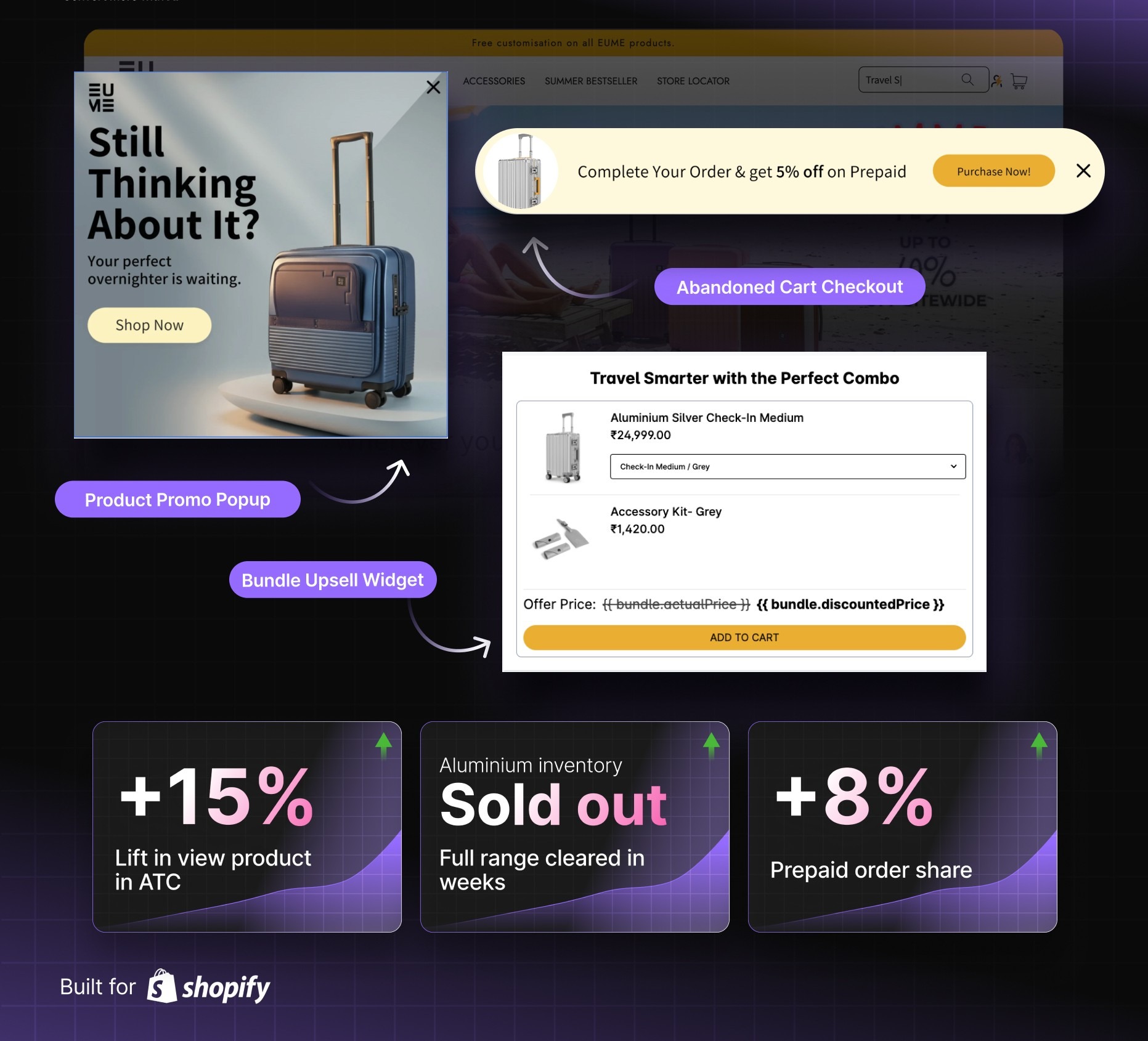
Cooee deployed a Gift With Purchase (GWP) bundle experience, triggered behaviorally for visitors browsing the Aluminium range. Instead of reducing the price, the campaign raised the perceived value of buying at full price. A curated travel accessory included at no additional cost.
The GWP resolved buyer hesitation without touching the price signal. The Aluminium bag's reference price stayed intact for every future visitor.
The bundle was surfaced only to visitors actively browsing the Aluminium collection — behaviorally targeted, not sitewide.
The same structure is directly replicable: a packing cube for trolleys, a cable organiser for tech-travel bags, a travel pouch for backpacks. The playbook holds across any premium SKU that stalls.
The Aluminium range cleared in weeks. Zero markdowns, full brand equity preserved, and a repeatable inventory playbook established that Eume can deploy on any future slow mover.
03 — Prepaid Nudge at Checkout
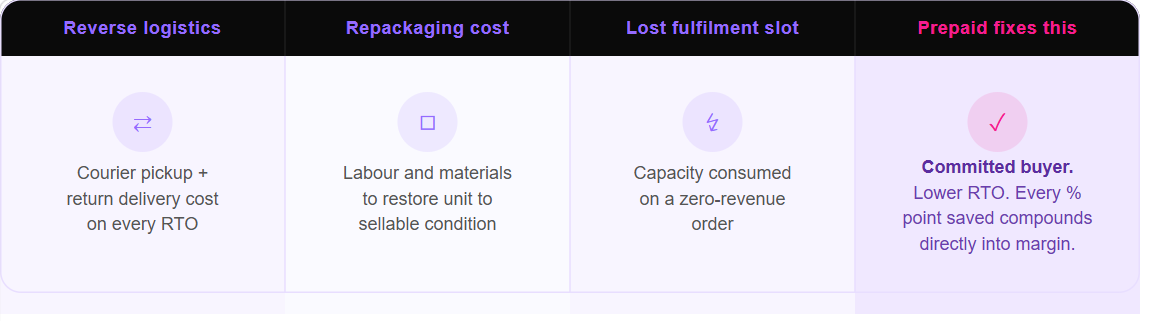
Cash on Delivery is ubiquitous in Indian D2C because it reduces purchase friction and drives conversion. But a COD-heavy order mix carries a structural cost that rarely shows up in campaign-level reporting: Return to Origin, or RTO. An RTO is not just a returned order, it is a cascade.
RTO Cascade
Cooee surfaced a prepaid nudge at the right moment in Eume's checkout flow, framed around the benefit to the buyer (faster dispatch, priority processing) rather than as a brand preference. The friction of switching payment methods was reduced, and the choice felt natural rather than pressured.
The result was an 8% shift in the payment mix. Every percentage point of prepaid penetration reduces the RTO-exposed order base, translating directly into reverse logistics savings, lower repackaging costs, recovered fulfilment capacity, and improved cash flow.
Moving 8% of orders to prepaid is deceptively valuable. COD-heavy mixes inflate RTO rates, which quietly destroy margin. Every percentage point shifted to prepaid saves on reverse logistics, repackaging, and lost fulfilment cost and that saving compounds at scale.
Results
Across all three initiatives, Cooee's personalization layer generated measurable impact at every stage of Eume's funnel without increasing ad spend, without discounting, and without engineering changes to the storefront.
Campaign / Initiative
Result
Funnel Stage
What it Fixed
UTM Collection Tiles
+15% view-product & ATC rate
Top-of-funnel
Intent mismatch on landing
GWP Bundle - Aluminium
Full range cleared in few weeks
Mid-funnel / inventory
Stalling premium SKU
Prepaid Nudge at Checkout
+8% prepaid order share
Bottom-of-funnel
COD-heavy payment mix / RTO
No additional traffic was acquired. No heavy development cycles. The impact came from reading real-time visitor intent and delivering the right experience at the right moment — at arrival, during product consideration, and at checkout.
Outcome
Eume didn't just run three campaigns, they built a smarter storefront.
By activating Cooee's intent-driven personalization layer across the full buyer journey, the brand transformed paid traffic into relevant experiences, moved premium inventory without eroding the price ladder, and improved the unit economics of every order, all without increasing ad spend or modifying their Shopify tech stack.
The programme validated a broader principle: for premium D2C brands, the biggest conversion gains don't come from more traffic or deeper discounts. They come from closing the gap between what a visitor signals they want and what the storefront shows them.
Industry Insight
This is not just an Eume story. It is a playbook for every premium D2C brand sitting on the same three problems.
For considered-purchase categories like travel gear and premium luggage, the gap between browsing and buying is rarely about price. It is about relevance, confidence, and timing. When visitors are shown the right product, in the right context, at the right moment, purchase decisions happen faster and more consistently.
1. Relevance at arrival beats any downstream offer — The UTM tile result proves it: a 15% ATC lift with zero discounts or promotions purely from showing the right navigational frame to a travel-intent visitor. Intent-matching on landing is the highest-leverage CRO action available on any D2C storefront.
2. Premium brands have a different inventory problem — The instinct to discount is right for a commodity SKU with elastic demand. It is wrong for a product where price is part of the positioning. When a premium SKU stalls, the question is not "how much do we cut?" It is "what can we add?" GWP answers that without touching the price ladder.
3. Unit economics live in the payment mix — RTO is one of the most underleveraged levers in Indian D2C. It does not appear as a campaign line item, which means the brands most exposed to it are least aware of it. An 8% shift to prepaid is not a small win. At scale, it is a structural improvement to the cost of every order in the mix.
4. Each play is independently replicable — None of these campaigns required deep engineering or custom tooling. UTM tiles extend to every paid channel. GWP bundles apply to any premium SKU that slows. Prepaid nudges are testable across checkout moments and incentive structures. The playbook repeats without rebuilding from scratch.
Weekly newsletter
No spam. Just the latest releases and tips, interesting articles, and exclusive interviews in your inbox every week.
Thank you! Your submission has been received!
Oops! Something went wrong while submitting the form.
Ready to supercharge your e-commerce conversions?
Learn how Cooee can help you tap into the potential of visitor intent and drive more sales!